Rancho Verde — wide-lot Eichlers and upscale designs
Built 1960–62 in central Sunnyvale, Rancho Verde (about 180 homes with its small addition) was Eichler's push toward larger lots and more custom designs — including the first Sunnyvale debut of the Claude Oakland Gallery model and a handful of dramatic double A-frames. It's quiet, unusually original, and beloved by design enthusiasts.
Eichler goes bigger and more custom
The main Rancho Verde tract was built in 1960, adding about 140 Eichler homes bounded roughly by S. Mary Avenue, Ticonderoga Drive, Trenton Drive and Plum Avenue. In 1962 the Rancho Verde Addition — about 40 homes on Sherwood Drive, Susquehanna Court and extensions of Ticonderoga and Mary, sometimes called “Fairbrae 5” by locals — was built as a more upscale phase.
Rancho Verde was the first Sunnyvale tract to debut the Claude Oakland “Gallery” model: an elongated gallery hallway for displaying art, and a more custom feel overall. Together the two sections total about 180 homes and marked the final major Eichler development west of downtown Sunnyvale.
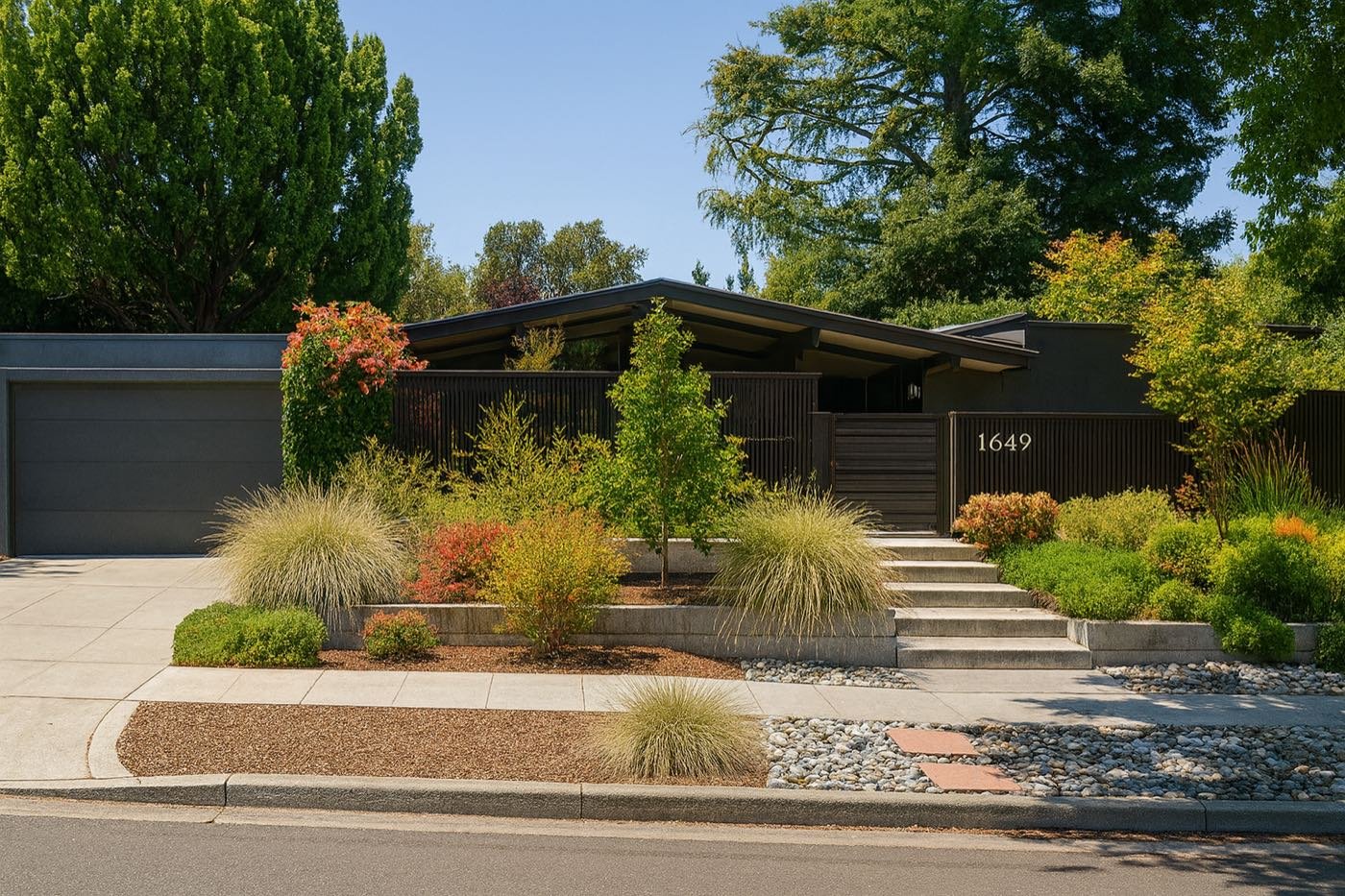

The most architectural variety per square foot in Sunnyvale
Rancho Verde is beloved for its range: classic flat-roof Eichlers, low-gabled models, and a few showstoppers — steep A-frame peaks and even some double A-frame facades (twin gables framing an exaggerated atrium entrance). Only a handful of double A-frames were built across all Eichler tracts, so having them here is a signature.
The 1962 addition's Gallery model added a long windowed hallway along the atrium — a floor-plan element new to Eichlers at the time — plus more custom touches like built-in planters and varied window placements. Every home still centers on an open-air atrium or patio, floor-to-ceiling glass and post-and-beam construction.
Lots are generous, many over 8,000 square feet, allowing broad frontages and more yard than Eichler's earlier subdivisions. Combined with the consistent one-story height and mature trees, the neighborhood feels airy — a snapshot of 1960s California Modernism, remarkably intact.
Rancho Verde at a glance
- Built
- 1960 (main tract), 1962 (addition)
- Size
- ~180 homes; wide lots, many over 8,000 sq ft
- Architecture
- Claude Oakland Gallery model, double A-frame and atrium plans — the widest range of any Sunnyvale tract
- Streets
- S. Mary Avenue, Ticonderoga, Trenton, Plum, Sherwood, Susquehanna Court
- Layout
- A maze of cul-de-sacs with one or two entry points off Mary Avenue — minimal through-traffic
- Schools
- Cumberland Elementary, Sunnyvale Middle, Fremont or Homestead High (location-dependent)
- Parks
- Serra Park and Las Palmas Park nearby; Fremont High's public courts border the south
- Price range
- Roughly $2.0M to $3.3M — historically a slight discount to Fairbrae, now closing
- The draw
- Preservation, space, and rare models — the closest thing Sunnyvale has to a collector's tract
The “hidden gem” that isn't hidden anymore
Rancho Verde long flew under the radar next to Fairbrae — wider streets, bigger lots, better-preserved homes, slightly lower prices. That gap is closing fast.
- Prices. Homes now commonly sell in the $2.0M–$3.3M range, with demand climbing as mid-century enthusiasts recognize the lot size and unique models.
- Originality. “Best-preserved Eichlers in the city” genuinely applies — many houses still have original Philippine mahogany paneling, Eichler cabinetry and unpainted ceilings. When originals list, they're often true time capsules.
- Turnover. Low. Some families have been here since the 1960s; the last decade brought a wave of tech families buying from original owners, usually with sympathetic remodels.
- Rarity premium. Double A-frame and Gallery models spark bidding wars, especially in spring when the cherry blossoms lining some streets are out.
- The alternative play. Increasingly seen as a quieter, more attainable stand-in for pricier Palo Alto or Los Altos Eichlers.
Neighborly warmth, low traffic, orchard-era trees
Because it's a small tract with limited through-traffic, many Rancho Verde residents know each other and form lasting friendships. Original owners live alongside young families — a real continuity of community, with long-timers sharing Eichler maintenance tips and newcomers organizing block get-togethers.
The single entry point off Mary Avenue makes the interior streets feel extra safe: kids play basketball in driveways and ride bikes without much worry about cars. Old cherry and apricot trees from former orchards still dot some yards, and every spring the blooms add a note of nostalgia. Neighbors wave as they pull into their Eichler carports — living mid-century here is about belonging to a small, proud community as much as the house.

What to know before you offer
Rancho Verde rewards patience and specificity. If you want a rare model (double A-frame, Gallery) or an unaltered original to restore, this is the tract to watch — but those spark competition, so define your must-haves and be ready.
The wide lots are a real asset for additions and landscaping. Confirm which school assignment a given block carries (Fremont vs. Homestead) before you fall in love.
Getting top dollar for your Eichler
If your home is an original — unpainted ceilings, mahogany intact, working radiant heat — say so loudly. Rancho Verde has a dedicated purist audience that pays for authenticity, and rare rooflines can clear well over asking.
Even for an updated home, keep the exterior and street view period-correct; the neighborhood's intact 1960s streetscape is part of what buyers are paying to join.
Rancho Verde, in pictures
Thinking about Rancho Verde?
Send us the address or the block you're watching. We'll tell you the plan, the condition issues to expect, the comps, and what it's worth — by hand.